
Ecommerce Google Ads strategy
In 2024, e-commerce businesses spent over $200 billion on Google Ads. Yet, a staggering 68% of stores failed to turn a profit. What sets the successful stores apart? A clear Ecommerce Google Ads strategy designed specifically for online retail—not recycled B2B campaigns.
This guide will walk you through every essential step—from optimizing Google Shopping campaigns to scaling with Performance Max and retargeting—so your e-commerce store can thrive profitably in 2025.
Why E-Commerce Needs a Unique Google Ads Strategy?
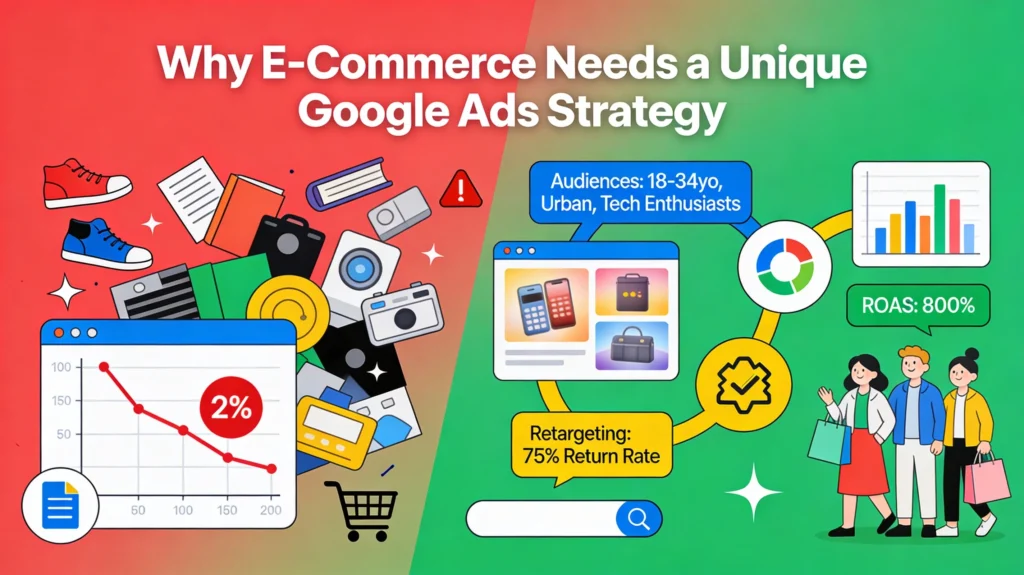
A strong Ecommerce Google Ads strategy is different from a standard Google Ads approach because:
Inventory constantly changes, impacting ad relevance
Customer behavior is seasonal and promotion-driven
Price comparison is easy, creating intense competition
Product visuals, pricing, and reviews directly influence clicks and sales
Without a tailored Ecommerce Google Ads strategy, even campaigns with high budgets can burn through money with little return
Suggested Account Structure for Your Ecommerce Google Ads Strategy
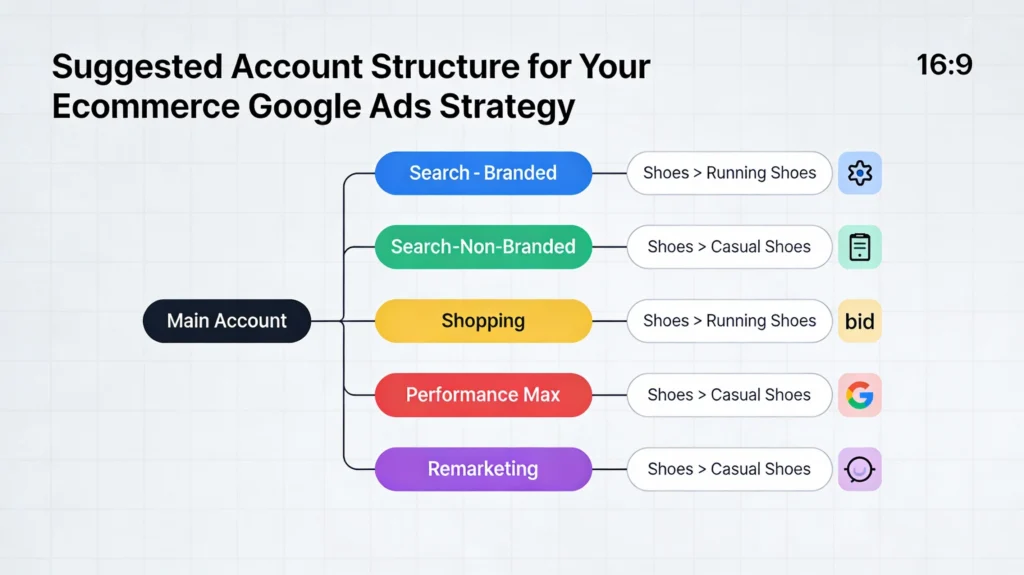
A well-organized account is the foundation of any Ecommerce Google Ads strategy. Here’s a structure that works:
Brand Protection: Target exact match brand terms
High-Intent Shopping: Focus on best-selling products
Generic Search: Cover product categories
Performance Max: Reach broad audiences efficiently
Display Remarketing: Capture abandoned carts
Video Campaigns: Build brand awareness
This setup ensures every stage of the buyer journey is covered while safeguarding your margins.
Key Metrics to Track
An effective Ecommerce Google Ads strategy monitors these crucial metrics:
ROAS: Aim for 4:1 or higher
CPA: Keep it under 25–30% of average order value
Shopping Impression Share: Target 70%+ on top products
CTR by Category: Compare with industry benchmarks
Tracking these KPIs lets you scale campaigns sustainably.
Google Shopping Campaigns in Your Ecommerce Google Ads Strategy
Optimizing Your Product Feed
Your product feed is the backbone of a high-performing Ecommerce Google Ads strategy:
Titles: Front-load with keywords (e.g., “Nike Air Max 270 Shoes Men Black”)
Categories: Use Google’s exact taxonomy
Images: Minimum 1000x1000px, include lifestyle shots
Pricing: Keep updated; use sale_price annotations
Structuring Shopping Campaigns
Use priority settings (High/Medium/Low) to manage traffic
Segment campaigns by product category or margin group for better bidding control
Bidding Strategies
Start with Enhanced CPC or Manual CPC for control
Switch to Target ROAS once enough conversion data is collected
A well-structured Shopping campaign is a core element of any strong Ecommerce Google Ads strategy.
Performance Max Campaigns for E-Commerce

Performance Max campaigns allow your ads to show across Google Search, Shopping, Display, YouTube, Discover, and Maps.
Core Assets for Performance Max
Product and lifestyle images
Demo or testimonial videos
Benefit-focused headlines
Short and long-form descriptions
Audience Signals
Customer Match (email uploads)
Website visitors and cart abandoners
Interest-based and demographic data
Optimization Routine
Review asset group reports weekly
Refresh creatives and audience signals regularly
Use feed rules to align campaigns with inventory and demand
Performance Max is a critical part of a modern Ecommerce Google Ads strategy.
Conversion Tracking & Attribution
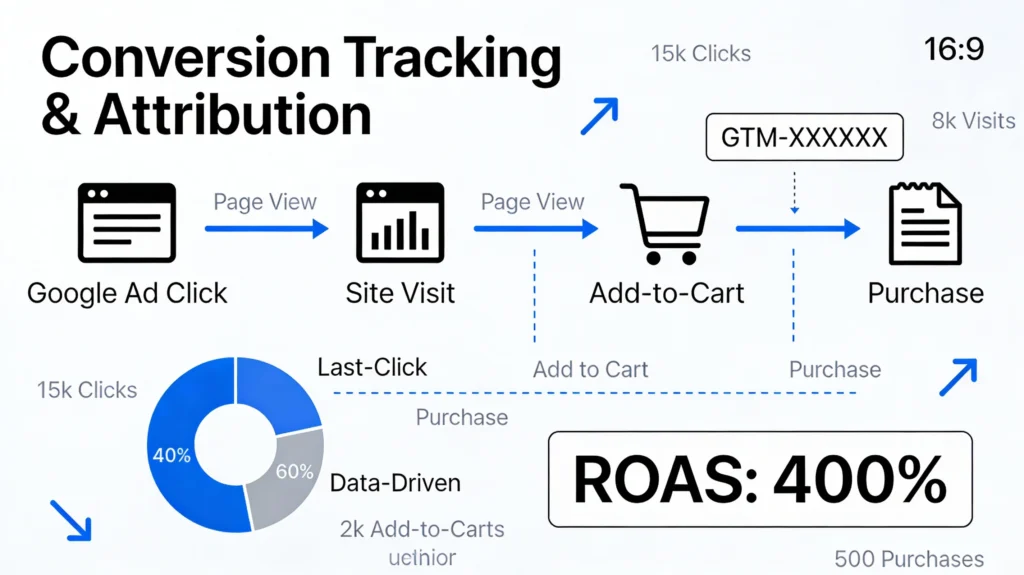
Tracking Setup
Track purchases, add-to-carts, checkout starts, and email signups
Implement Enhanced Conversions
Integrate GA4 for full-funnel reporting
Attribution Modeling
Data-Driven: Ideal if account volume is high
Time Decay: Useful for short-term promotions
Linear: Best when multiple touchpoints exist
Accurate tracking is essential for evaluating the success of your Ecommerce Google Ads strategy.
Ecommerce Google Ads Trends for 2026
-
AI: Smarter creative testing, predictive bidding, and improved asset selection
-
Privacy: GA4 and Enhanced Conversions are now standard
-
Voice Search: Optimize product feed titles for natural language queries
-
Inventory-Aware Bidding: Automate bids based on stock availability
Staying ahead of these trends keeps your Ecommerce Google Ads strategy profitable and future-proof. CONTACT US to help you scale your brand.